Table of Contents
I still remember the meeting that changed how I report on SEO. Traffic was climbing. Rankings looked healthy. And yet, leads and conversions were quietly sliding in the wrong direction. That gap between “the dashboard looks great” and “the business isn’t growing” is exactly why the old way of measuring AI search SEO KPIs doesn’t hold up anymore.
The client was an e-commerce business. When I dug into what was happening, the rankings hadn’t actually dropped much — but the keywords bringing people to the site had shifted in intent. Visitors were still arriving in similar numbers, just for different reasons, and those reasons no longer matched what the business was selling. Traffic was up. Revenue wasn’t.
That experience taught me something I now build every SEO report around: visibility metrics and business metrics are not the same thing, and treating them as interchangeable is one of the most common — and costly — mistakes in SEO today.
Why Traditional SEO Metrics Fall Short in the AI Search Era
Search itself has changed. AI Overviews, generative answers, and zero-click results mean fewer people click through even when your content ranks well. A page can technically “win” the SERP and still contribute nothing to the business.
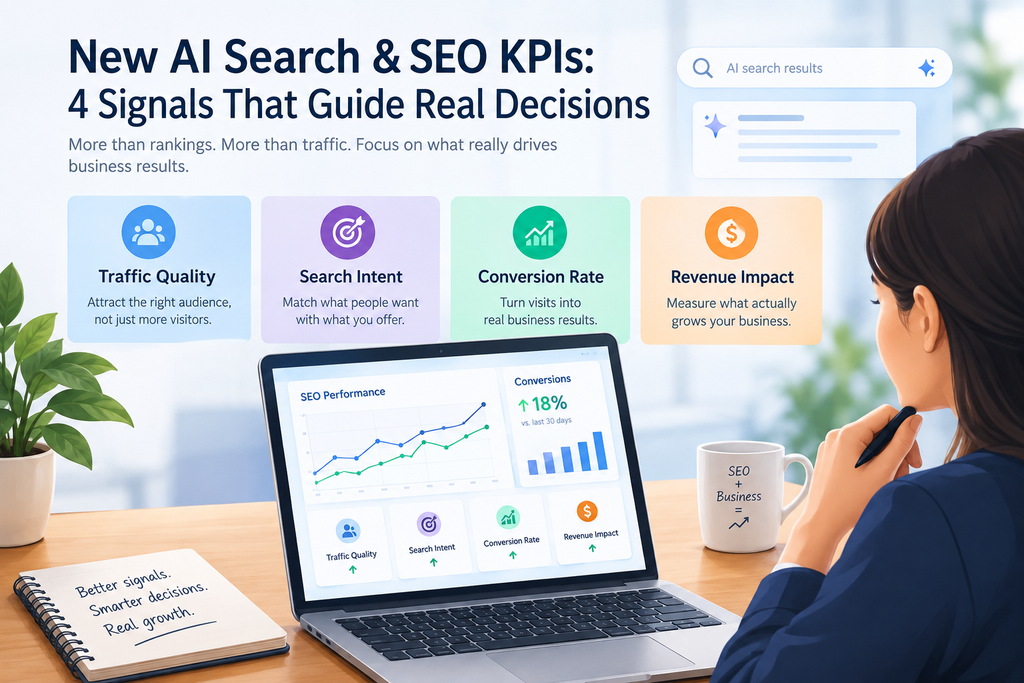
That’s why I’ve moved away from rankings-and-sessions reporting and toward four core AI SEO metrics that actually explain what’s happening underneath the surface.
The 4 Signals That Guide Real SEO Decisions
- 1. Traffic Quality
Not all traffic is equal, and rising numbers can hide a falling-quality problem. I look at where visitors are landing, how they got there, and whether the pages attracting the most traffic are the ones that should be attracting it. A spike in sessions from an irrelevant query or a low-intent keyword often looks like a win on a dashboard — and it isn’t.
- 2. Search Intent
This is where the e-commerce case really opened my eyes. The queries hadn’t disappeared; their intent had drifted. People searching a keyword last year may want something different from it today, especially as AI-generated answers reshape how people phrase and expect responses to searches. Reviewing intent regularly — not just once, at the content-planning stage — is now a permanent part of my process.
- 3. Conversion Rate
This is the metric I track most closely day to day. I use GA4 to compare organic conversions against traffic trends, because that comparison is where problems surface first. If organic traffic is climbing while the conversion rate drops significantly, something in the intent-to-business match has broken.
In practice, a sustained 15–20% drop in organic conversion rate is my trigger point. When I see that, I don’t guess — I segment the data by landing page, query, device, and traffic source. That segmentation almost always narrows the problem down to one or two specific pages or query groups, rather than the site as a whole.
- 4. Revenue Impact
Rankings and traffic are proxies. Revenue is the outcome. Connecting SEO activity back to actual revenue — not just assisted conversions in an attribution model, but real business results — is what separates SEO reporting that gets budget renewed from reporting that gets questioned.
A Simple Framework for Diagnosing a Conversion Drop
| Step | What to check | What it tells you |
| 1. Segment by landing page | Which pages lost conversions | Where the problem lives |
| 2. Segment by query | Which keywords changed in intent | Why visitors stopped converting |
| 3. Segment by device | Mobile vs. desktop performance gaps | Whether it’s a UX or technical issue |
| 4. Segment by traffic source | Organic vs. paid vs. referral | Whether it’s search-specific or site-wide |
This is the same process I use with clients, and it’s repeatable regardless of industry.
The Mistake I See Most Often
Too many marketers — and honestly, too many clients — still treat rankings and traffic as the finish line. When those numbers don’t translate into leads, sales, or revenue, the instinct is often to push for more content or more keywords, rather than asking why the existing traffic isn’t converting.
The fix isn’t more SEO activity. It’s connecting SEO KPIs directly to business outcomes, and specifically measuring the quality and conversion behavior of the traffic already coming in.
FAQs
What are the most important AI search SEO KPIs to track in 2026?
Traffic quality, search intent alignment, conversion rate, and revenue impact — together, not in isolation.
Why isn’t ranking position enough anymore?
AI Overviews and zero-click search mean high rankings don’t guarantee clicks or business impact. A page can rank well and still underperform on revenue.
How do I know if a conversion rate drop is a real problem?
A sustained 15–20% drop in organic conversion rate, confirmed over more than a short spike, is a reasonable threshold to start investigating.
Conclusion: Start Measuring What Actually Matters
The old scorecard — rankings and traffic — isn’t wrong, but it’s incomplete. The four AI search SEO KPIs above (traffic quality, search intent, conversion rate, and revenue impact) give a fuller, more honest picture of whether your SEO work is actually moving the business forward.
This week, don’t just check your rankings. Audit your organic traffic by conversion rate and revenue instead. Find one high-traffic page with weak conversions, and dig into why that traffic isn’t turning into business — that single exercise usually reveals more than a month of ranking reports ever will.
SEO Title: New AI Search & SEO KPIs: 4 Signals That Guide Real Decisions
Meta Description: Rankings and traffic no longer tell the full story. Learn the AI search SEO KPIs that actually reveal whether your content drives real business results.
URL Slug: /ai-search-seo-kpis-signals
New AI Search & SEO KPIs: 4 Signals That Guide Real Decisions
I still remember the meeting that changed how I report on SEO. Traffic was climbing. Rankings looked healthy. And yet, leads and conversions were quietly sliding in the wrong direction. That gap between “the dashboard looks great” and “the business isn’t growing” is exactly why the old way of measuring AI search SEO KPIs doesn’t hold up anymore.
The client was an e-commerce business. When I dug into what was happening, the rankings hadn’t actually dropped much — but the keywords bringing people to the site had shifted in intent. Visitors were still arriving in similar numbers, just for different reasons, and those reasons no longer matched what the business was selling. Traffic was up. Revenue wasn’t.
That experience taught me something I now build every SEO report around: visibility metrics and business metrics are not the same thing, and treating them as interchangeable is one of the most common — and costly — mistakes in SEO today.
Why Traditional SEO Metrics Fall Short in the AI Search Era
Search itself has changed. AI Overviews, generative answers, and zero-click results mean fewer people click through even when your content ranks well. A page can technically “win” the SERP and still contribute nothing to the business.
That’s why I’ve moved away from rankings-and-sessions reporting and toward four core AI SEO metrics that actually explain what’s happening underneath the surface.
The 4 Signals That Guide Real SEO Decisions
1. Traffic Quality
Not all traffic is equal, and rising numbers can hide a falling-quality problem. I look at where visitors are landing, how they got there, and whether the pages attracting the most traffic are the ones that should be attracting it. A spike in sessions from an irrelevant query or a low-intent keyword often looks like a win on a dashboard — and it isn’t.
2. Search Intent
This is where the e-commerce case really opened my eyes. The queries hadn’t disappeared; their intent had drifted. People searching a keyword last year may want something different from it today, especially as AI-generated answers reshape how people phrase and expect responses to searches. Reviewing intent regularly — not just once, at the content-planning stage — is now a permanent part of my process.
3. Conversion Rate
This is the metric I track most closely day to day. I use GA4 to compare organic conversions against traffic trends, because that comparison is where problems surface first. If organic traffic is climbing while the conversion rate drops significantly, something in the intent-to-business match has broken.
In practice, a sustained 15–20% drop in organic conversion rate is my trigger point. When I see that, I don’t guess — I segment the data by landing page, query, device, and traffic source. That segmentation almost always narrows the problem down to one or two specific pages or query groups, rather than the site as a whole.
4. Revenue Impact
Rankings and traffic are proxies. Revenue is the outcome. Connecting SEO activity back to actual revenue — not just assisted conversions in an attribution model, but real business results — is what separates SEO reporting that gets budget renewed from reporting that gets questioned.
A Simple Framework for Diagnosing a Conversion Drop
| Step | What to check | What it tells you |
| 1. Segment by landing page | Which pages lost conversions | Where the problem lives |
| 2. Segment by query | Which keywords changed in intent | Why visitors stopped converting |
| 3. Segment by device | Mobile vs. desktop performance gaps | Whether it’s a UX or technical issue |
| 4. Segment by traffic source | Organic vs. paid vs. referral | Whether it’s search-specific or site-wide |
This is the same process I use with clients, and it’s repeatable regardless of industry.
The Mistake I See Most Often
Too many marketers — and honestly, too many clients — still treat rankings and traffic as the finish line. When those numbers don’t translate into leads, sales, or revenue, the instinct is often to push for more content or more keywords, rather than asking why the existing traffic isn’t converting.
The fix isn’t more SEO activity. It’s connecting SEO KPIs directly to business outcomes, and specifically measuring the quality and conversion behavior of the traffic already coming in.
FAQs
What are the most important AI search SEO KPIs to track in 2026?
Traffic quality, search intent alignment, conversion rate, and revenue impact — together, not in isolation.
Why isn’t ranking position enough anymore?
AI Overviews and zero-click search mean high rankings don’t guarantee clicks or business impact. A page can rank well and still underperform on revenue.
How do I know if a conversion rate drop is a real problem?
A sustained 15–20% drop in organic conversion rate, confirmed over more than a short spike, is a reasonable threshold to start investigating.
Conclusion: Start Measuring What Actually Matters
The old scorecard — rankings and traffic — isn’t wrong, but it’s incomplete. The four AI search SEO KPIs above (traffic quality, search intent, conversion rate, and revenue impact) give a fuller, more honest picture of whether your SEO work is actually moving the business forward.
This week, don’t just check your rankings. Audit your organic traffic by conversion rate and revenue instead. Find one high-traffic page with weak conversions, and dig into why that traffic isn’t turning into business — that single exercise usually reveals more than a month of ranking reports ever will.
Looking for an SEO expert in Kochi to improve your website’s visibility and attract more qualified traffic? A professional SEO expert in Kochi can help businesses build a strong search presence through keyword research, on-page optimization, technical SEO, quality content, and local SEO strategies. Whether you run a startup, local business, or growing brand, working with an experienced SEO professional can help you reach the right audience and strengthen your online presence in Kochi and beyond.