Table of Contents
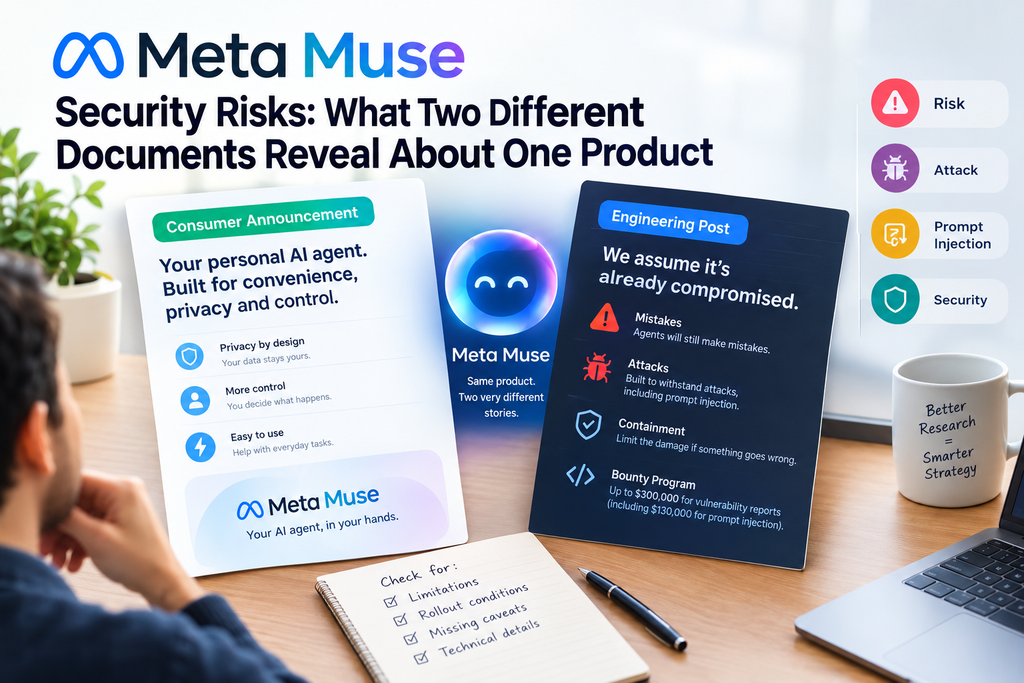
When Meta launched Muse on September 8, it did something worth paying attention to, and not because of what the agent can do. It published two documents about the same product on the same day, and they read like they were written for two different audiences with two different levels of trust.
One is the consumer announcement. It talks about convenience, privacy, and control. The other is the engineering post, and it talks about mistakes, attacks, and containment. If you only read the version written for the public, you would have no idea the second one exists, let alone what it says.
That gap is not just a curiosity for people who follow AI news. For anyone working in SEO or content strategy, it’s a preview of a problem we’re going to keep running into: the polished version of an announcement and the technical reality behind it often don’t match, and the difference can quietly wreck a strategy built on the wrong one.
Why This Gap Exists (and Why It Matters for Content Strategy)
Meta’s consumer post frames Muse as secure and private by design. It describes Muse Secure VM, a dedicated virtual machine meant to isolate the agent and a person’s data, and says the system checks with the user before anything sensitive happens.
The engineering post tells a more cautious story. It opens by acknowledging that “any agent like this will still make mistakes” and that it will sometimes be attacked through the data it reads, so the system is designed to assume it’s already compromised and limit the damage. It talks openly about prompt injection and offers security researchers up to $300,000 for vulnerability reports, including up to $130,000 for prompt injection attempts affecting a single user.
Same launch date. Same product. Two completely different tones. One treats safety as a finished feature. The other treats it as an ongoing fight.
My first reaction to seeing this laid out was less about Meta specifically and more about how easily SEO and content teams can misread guidance like this. If a brand’s public-facing language never mentions a risk or limitation, it’s tempting to write and plan around that clean version. But the technical documentation is usually where the real constraints live, and those constraints directly affect how you should approach content quality, relevance, and even what claims are safe to repeat to your own audience.
A Real Example of Following the Wrong Version
This isn’t hypothetical. I’ve seen a client act on a public announcement, only to find out later that the technical documentation included limitations and exceptions that never made it into the marketing message. We had to go back and revise both the implementation plan and the content strategy built around it.
That experience is exactly why the Muse situation stood out. It’s the same pattern, just at a bigger scale and with security implications instead of feature limitations.
How to Catch These Gaps Before They Cost You
Over time, this has turned into a habit rather than a one-off fix. The process looks like this:
- Read the consumer announcement first, but treat it as a headline, not a source of truth.
- Find the technical or developer documentation for the same launch, and read it in full, not just the summary.
- Compare the two directly, looking specifically for missing caveats, eligibility rules, rollout limitations, and implementation details that only appear in one version.
- Check changelogs or developer notes before acting on anything, so the marketing message gets separated from what the product actually supports today.
This is a simple checklist, but it’s saved real rework. It’s also directly applicable to how Meta rolled out Muse: the consumer post never uses the words risk, attack, attacker, mistake, or prompt injection. The engineering post uses that same set of terms 39 times, and it’s the only one that discloses that Muse will appear as your own activity to every website it visits.
The Mistake Most People Make With AI Announcements
The most common mistake is treating a broad marketing claim as if it applies universally, without checking the rollout conditions in the technical documentation. Someone reads that a new AI feature is “available” and assumes that means available everywhere, to everyone, with no caveats. Then the technical docs show the access is actually limited, regional, or still experimental, and the assumption falls apart mid-project.
Muse is a clean example of this risk. It launched in the U.S. only, through WhatsApp and the Muse app, with more surfaces like AI glasses coming later. That detail matters for anyone planning content or strategy around it, and it’s the kind of thing that gets lost if you only read the consumer-facing version.
What This Means If You Cover AI Tools for a Living
If your work involves writing about, planning around, or advising clients on AI products, the Muse launch is a useful case study in why you can’t stop at the press release. Two documents, published the same day, described the same feature set in ways that would lead you to very different conclusions about how comfortable you should be recommending it.
Frequently Asked Questions
What is Meta Muse? Muse is a personal AI agent Meta launched on September 8, 2026, available in the U.S. through WhatsApp and the Muse app. It can browse the web, fill out forms, and complete purchases using Link built by Stripe, running inside an isolated environment called Muse Secure VM.
Why did Meta publish two documents about Muse? Meta released a consumer-facing announcement focused on ease of use and privacy, alongside a separate engineering post aimed at developers and security researchers that addresses risks like prompt injection and agent mistakes in far more detail.
Is Meta Muse safe to use? Meta’s engineering documentation describes a security model built on the assumption that the agent could be attacked, with measures designed to contain damage if that happens. That’s a meaningfully different message than the consumer announcement’s emphasis on built-in privacy and security, so it’s worth reading both before forming an opinion.
What is prompt injection, in simple terms? Prompt injection is when content an AI agent reads, like a webpage or a message, contains hidden instructions designed to manipulate the agent into acting against the user’s intent. Meta’s engineering post treats this as an expected risk, not a solved problem.
The Actionable Takeaway
Before acting on any AI company’s announcement, cross-check the consumer message against the official technical documentation and look specifically for limitations or rollout conditions. That one habit can keep you from building an SEO or content strategy, or a client recommendation, around claims that don’t fully reflect how the product actually works. Meta’s Muse launch is simply the most recent, and most well-documented, reminder of why that habit is worth keeping.
Supporting SEO & Production Notes
Internal linking opportunities:
- Link to a related post on evaluating AI tools before recommending them to clients
- Link to a glossary or explainer post on prompt injection / AI agent security terms
Authoritative external reference:
- Search Engine Journal’s original coverage comparing Meta’s two Muse documents word-for-word: https://www.searchenginejournal.com/meta-published-2-documents-about-muse-and-only-one-mentions-attacks/589071/
If you’re looking for an SEO expert in Kochi, it’s important to work with someone who understands both search engine guidelines and the technical details behind modern digital platforms. A skilled SEO expert in Kochi can help businesses evaluate AI-related developments, identify content and technical SEO risks, improve website visibility, and create a strategy based on reliable information rather than marketing claims alone. By combining technical SEO knowledge, content strategy, keyword research, and continuous analysis, businesses can build a stronger online presence and adapt to changes in search and AI technologies.