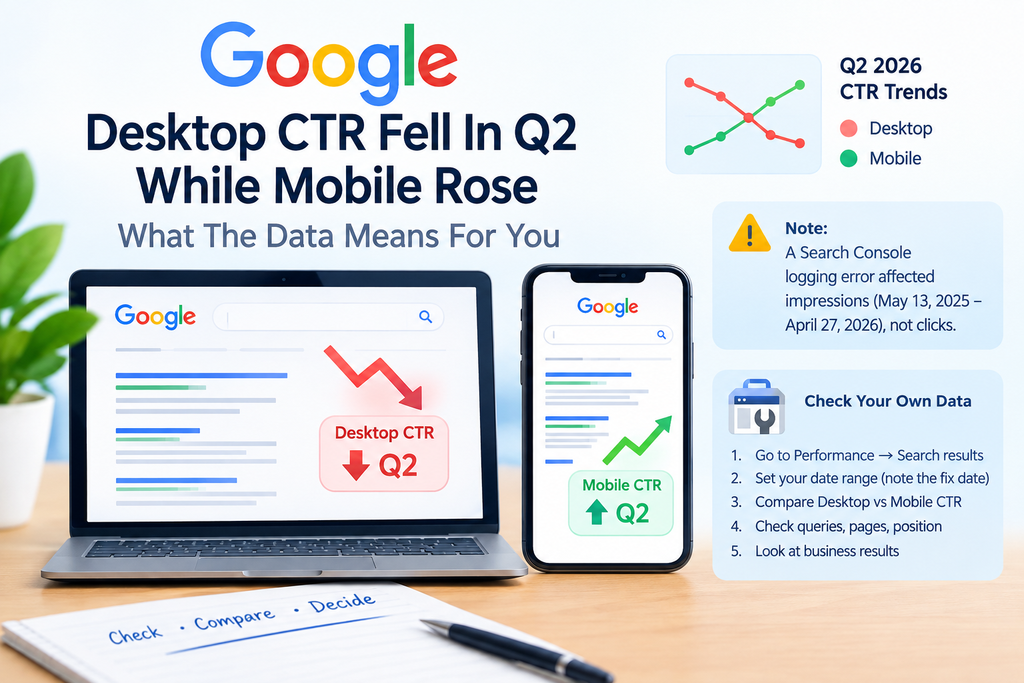
Google desktop CTR dropped at the top organic positions in Q2 2026, while mobile click-through rates climbed. That’s the headline from Advanced Web Ranking’s latest report. But before you rewrite titles or panic about a client’s traffic, there’s a catch that changes how you should read these numbers. Here’s what the data shows, why a Search Console error matters, and how to check your own device-level CTR.
What The Q2 Google Desktop CTR Data Shows
The report compares average international CTRs by position, April to June against January to March. Desktop positions one and two lost a combined 5.27 percentage points, while mobile in those same spots gained a combined 6.59. These figures add up changes across positions, so they don’t describe any single site.
A few more details stand out:
- For single-word queries, desktop position one fell 4.15 points while mobile rose 7.42.
- Every top-20 desktop branded CTR dropped, by between 1.47 and 3.08 points, while mobile position one gained 1.40.
- Law, Government & Politics had the biggest single-position jump, at mobile position one (+17.31), while Style & Fashion had the steepest drop, at desktop position one (-13.31).
This reverses the Q1 pattern, when desktop rates rose and mobile fell at the top. One quarter doesn’t make a trend, and AWR says its Q3 report will show whether the split is lasting or seasonal.
Why You Should Be Careful Before Trusting These Numbers
The Search Console logging error
This is the part most summaries skip. Google’s help page says a logging error misreported impressions from May 13, 2025 to April 27, 2026. It affected CTR and average position, but not click counts. AWR’s CTR tool draws on Search Console data, so Q1 sat entirely inside that window while most of Q2 came after the fix.
CTR is clicks divided by impressions. If impressions were wrong, the change between Q1 and Q2 could partly reflect a measurement break instead of a change in user behavior. The same caution applies to your own year-over-year comparisons.
AI Overviews widen the gap
In U.S. data, desktop positions one and two combined earned a 29.05% CTR on pages without an AI Overview, but only 10.04% on pages with one. On mobile, position one fell from 35.95% without an AI Overview to 8.51% with one. So device mix isn’t the only story. The search result page itself matters too.
How To Check Device-Level CTR In Your Own Search Console
I haven’t compared device CTR on a client site yet, so this section is a repeatable process, not a case study. Here’s the order I’d follow:
- Open your property in Search Console and go to Performance → Search results.
- Set two equivalent date ranges. Keep the April 27, 2026 fix date in mind.
- Turn on clicks, impressions, average CTR and average position.
- Click + New → Device, then select Desktop. Repeat for Mobile.
- Compare CTR between the two devices.
- Open the Queries and Pages tabs to see what’s driving the gap.
- Read impressions and position next to CTR. Never judge CTR alone.
- Confirm the change holds over weeks, not just a few days.
- Compare conversions or other business metrics.
Compare the same pages and queries on both devices. Mixing different query sets produces misleading results.
What your results might mean
| What you see | Possible cause | What to check |
| Desktop CTR down, impressions up | More low-intent impressions | Query mix, average position |
| CTR shift near late April 2026 | Logging error fix | Date of the change |
| Drop only on AI Overview queries | Answer shown above results | SERP for those queries |
| CTR down, clicks stable | Impression changes, not lost traffic | Raw click counts |
Should You Care About A Desktop CTR Drop?
If a client asks, my answer is: “Yes, it’s worth investigating, but it’s not automatically a problem.” A CTR drop can come from SERP features, shifting intent, ranking position, device mix or seasonality. If mobile brings valuable traffic while desktop CTR falls without hurting conversions, there may be little to worry about. If desktop clicks or conversions also decline, dig into the affected queries and results pages.
The key is to look at business impact, not CTR in isolation.
Common Mistakes To Avoid
- Assuming a CTR drop means the page got worse
- Comparing periods that cross the April 27 fix without noting it
- Treating one quarter of data as a trend
- Judging CTR without checking position and impressions
- Comparing different query sets across devices
FAQ
Did Google desktop CTR really fall in Q2 2026?
In AWR’s dataset, yes, at the top positions. But the comparison spans a Search Console error fix, so treat it as a signal to investigate, not a proven shift in behavior.
Does the logging error affect my click numbers?
No. Google says it affected impressions, CTR and average position, but not clicks.
Should I optimize differently for mobile now?
Not based on this data alone. Check your own device-level results first.
Conclusion: Verify Before You Act
The Google desktop CTR decline in Q2 is interesting, but it isn’t a verdict. This week, do one thing: compare desktop and mobile CTR in Search Console for the same pages and queries over a meaningful period, and note the April 27 fix date. Then decide whether any change is justified.